Showing posts with label second person. Show all posts
Showing posts with label second person. Show all posts
3.7.07

2.7.07
The Great Stone Face

… At the hour of sunset, as had long been his frequent custom, Ernest was to discourse to an assemblage of the neighboring inhabitants, in the open air. He and the poet, arm in arm, still talking together as they went along, proceeded to the spot. It was a small nook among the hills, with a gray precipice behind, the stern front of which was relieved by the pleasant foliage of many creeping plants, that made a tapestry for the naked rock, by hanging their festoons from all its rugged angles. At a small elevation above the ground, set in a rich frame-work of verdure, there appeared a niche, spacious enough to admit a human figure, with freedom for such gestures as spontaneously accompany earnest thought and genuine emotion. ... In another direction was seen the Great Stone Face, with the same cheer, combined with the same solemnity, in its benignant aspect.
Ernest began to speak, giving to the people of what was in his heart and mind. His words had power, because they accorded with his thoughts; and his thoughts had reality and depth, because they harmonized with the life which he had always lived. It was not mere breath that this preacher uttered; they were the words of life, because a life of good deeds and holy love was melted into them. Pearls, pure and rich, had been dissolved into this precious draught. The poet, as he listened, felt that the being and character of Ernest were a nobler strain of poetry than he had ever written. His eyes glistening with tears, he gazed reverentially at the venerable man, and said within himself that never was there an aspect so worthy of a prophet and a sage as that mild, sweet, thoughtful countenance, with the glory of white hair diffused about it. At a distance, but distinctly to be seen, high up in the golden light of the setting sun, appeared the Great Stone Face, with hoary mists around it, like the white hairs around the brow of Ernest. Its look of grand beneficence seemed to embrace the world.
At that moment, in sympathy with a thought which he was about to utter, the face of Ernest assumed a grandeur of expression, so imbued with benevolence, that the poet, by an irresistible impulse, threw his arms aloft, and shouted, "Behold! Behold! Ernest is himself the likeness of the Great Stone Face!"
Then all the people looked, and saw that what the deep-sighted poet said was true. The prophecy was fulfilled. But Ernest, having finished what he had to say, took the poet's arm, and walked slowly homeward, still hoping that some wiser and better man than himself would by and by appear, bearing a resemblance to the GREAT STONE FACE.
– Nathaniel Hawthorne, “The Great Stone Face” (1852)
30.6.07
Marriage
 Detail from "Madonna and Child"
The wind proposed to the snow. The snow and the wind plighted their troth, and a frost-fingered ship probed the pack-ice of their love. A bowsprit probed their season of intimacy.
Happiness is frozen in the froth of a cloud; it’s a light which freezes, then cracks. It’s a thicket of lilies infested with violet snakes, gliding between twilight and the sea, gliding across the blood-red lawns of twilight.
The whip cracks, streaking the snow of your first love. The wild beast falls asleep in a blood-streaked orchid.
– Maurice Blanchard
•
He said: my hoarse lips pant spotted
panthers who sing
sweeter than bellbirds in the bush
or the blood-streaked bulls of storm cumulus
He said:
Inside me I’ve got
steep salt waves
breaking over (so dainty) feast-day flowers
He called Our Lady
a little girl with a basket of vegetables
He said: Then he said:
I’m a poppy
clashing at dawn with pale blue animals
– Jacques Baron
29.6.07
Free Love
 Alessandro Allori, "Venus and Cupid" (c.1600)
Girl of the wood-ember hair
flash-photo wit
hourglass waist
otter-cub in the tiger’s jaws
bouquet of sunflowers in your mouth
teeth white mice tracks in the snow
teased-amber tongue
tongue stained blood-red by the Host
tongue of a Barbie batting her eyelids
alchemist’s tongue
lashes crayon slashes
swallowtail eyebrows
forehead fogged-up
greenhouse panes
champagne-flute shoulders
– dolphins butting through sea-ice –
matchstick wrists
card-sharp fingers / my Ace of Hearts
harvest-shock fingers
marten-fur armpits
(Midsummer bonfires
of blackbirds’ nests)
spindrift arms
ground fine as grain
skyrocket legs
sparking like clockwork / or despair
calves shoots from the Rata tree
feet like initials
feet like keyrings / feet like bung-taps
pearl-barley neck
whitewater throat / (my love-nest
in the torrent’s bed)
night-walking breasts
sea-otter breasts
crucified breasts
rosebud nipples spiked with dew
belly like a folded fan
a giant claw
your back / a jump-jet hovering
quicksilver back
beacon back
nuque of the neck / a rolling stone
a glass that shatters in your hand
coracle hips
flared hips
pale as a peacock
tipped head-over-heels
asbestos bum
swansdown behind
Spring booty
leaf-dagger sex
sex panning for gold / platypus pussy
sex soft as anemone/ jujube sweet
mirror sex
eyes pricked with tears
violet eyes / my magnetic north
nomad eyes
eyes water to a dying man
eyes one second from the chop
eyes deep as a well / eyes free as air / eyes dry earth and eyes
cool fire
– André Breton
28.6.07
Life on Mars

There’s a persistent tendency in humans to try to make sense out of everything they see. When Perceval Lowell turned his telescope on Mars, he saw canals. Saw them, mapped them, wrote about them. Others saw them too. The question is, would he ever have seen them at all if he hadn’t already read Schiaparelli’s claim to have observed canali – which translates as “channels” rather than “canals” – crisscrossing the red planet’s surface?
The Rorschach blot test demonstrates our ability to construct a meaning – a story even – out of random shapes and lines. How many of us have seen a figure waving at us beside a road at night, only to have it transform into a fencepost as we pass? Or else some long-lost loved one, turning a busy street-corner in front of us?
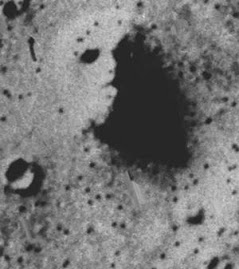
The so-called pyramid and face on Mars are surely little more than this. Coincidental shade effects recorded on a sole exposure, copied, talked about, enhanced until they’ve taken on the accoutrements of fact?
And yet. Is that all they are? Can there really have been life on Mars in some far distant epoch? Is there life there now? And, if life, has there ever been intelligence, civilisation, history? I guess the more relevant question is what we hope to achieve by asking?
The only hopeful thing about us, it sometimes seems, is our curiosity. We fondly imagine that the more that we find out, the happier we will become – the wiser, rather. This time we won’t go wrong because we’ve finally seen something amazing enough to matter. …
Submitted for your approval:
• In December 1984 the meteorite ALH84001 was found in Allan Hills, Antarctica. At c. 4.5 billion years old, this is one of the oldest pieces of the solar system still in existence, and it is thought to have originated on Mars. On closer examination, it revealed structures which may be the fossils of microscopic organisms, nanobacteria. At any rate, no completely convincing non-biological explanation has yet been submitted for these traces. Nor have experts ruled out the possibility that, in a far-distant past, such meteorites were instrumental in transferring life from a wet, fecund Mars to Earth.
• In March 2004, NASA announced that its remote-controlled robotic rover Opportunity had discovered evidence that Mars was, in the past, a wet planet. This evidence is mainly in the form of sedimentary bedrock deposits and erosion features difficult to account for under any other hypothesis.
• In December 2006, NASA presented images from its Mars Global Surveyor satellite which suggest that water still occasionally flows on the surface of Mars. While there were no actual pictures of flowing water, changes over time in the appearance of craters and dark spots in the landscape do strongly suggest that something has been flowing there. Dust, possibly, but then again, maybe the Red Planet's lifeblood, liquid water.
27.5.07
Trilogies (2)

The greatest detective who ever lived made a somewhat inauspicious debut in Beeton's Christmas Annual for 1887.

A Study in Scarlet combined a tale of detection with a lurid story of revenge set among the Mormon pioneers of Utah.

Its successor, The Sign of Four (1890) used essentially the same method to parallel contemporary London with India at the time of the Indian mutiny (1857-58).

The last in this series of "double-stories" was The Valley of Fear (1914) contrasting a brilliant piece of deduction by Holmes with a tale set among the "Molly Maguires," trade-union activists from the mining regions of Pennsylvania in the 1880s.
In each case the frame story is set in the present, whereas the recounted events date from thirty to forty years before (an exception to this pattern can be found in the only other Sherlock Holmes "long story," The Hound of the Baskervilles (1902), conceived originally as a tale of the supernatural rather than a straight Holmesian detective narrative.)

25.5.07
Night Journey

… Another voice came from an angel called Ismaïl, saying: “Heavenly stairs, show yourselves and descend!” upon which the ladder of heaven descended all the way from Firdaus, the loftiest paradise, until it reached the Temple of Solomon. The arms of the ladder shone with two heavenly lights, red amethyst and green jasper of the greatest perfection. Every believer is going to see that ladder and climb on it. It has one hundred steps and it goes from the temple to the first heaven.
Gabriel called Muhammad [peace be upon him] and the heavenly creature called the buraq carried him up the first step. There Muhammad [pbuh] saw all kinds of angels red in colour. On the second step, Muhammad [pbuh] saw angels in yellow cloth, on the third step the angels were green and all of them were greeting him and giving him heavenly gifts which he took and gave to Gabriel to keep as a trust for the believers on earth. On the fourth step messenger-angels came and said: "Gabriel, keep rising for the Lord is waiting!" And Muhammad [pbuh] saw their subtle bodies shining and their faces glittering like mirrors in the sun.
Then he climbed the fifth step of the ladder and saw a huge world of angels that had no beginning and no end. All of them were praising Allah and their only words were: "There is no God but Allah." He asked Gabriel: "How many are these angels?" for he was awed by their numbers. Gabriel said: "If the skies and the earth and the moon and the sun and the stars and galaxies were crushed into dust and were all piled up, their dust particles would not be one tenth of the angels of this step of the ladder of paradise." Then the buraq climbed up to the sixth step and there a great surprise awaited Muhammad [pbuh], and a great event took place which passed all description. An immense, white-upon-white angel sat on a chair of burnished white gold, accompanied by a great host of angels with wide, awe-struck gazes looking at the divine majesty. The white angel stood up and said: "Muhammad, welcome! I beg you to bless my seat by sitting on it." When Muhammad [pbuh] sat on the chair, it melted with love for him and became a cloud of multicolored light chanting the praise of Allah. Out of every drop of that cloud Allah created another throne and another great angel sitting upon that throne.
Then the buraq climbed to the seventh heaven and Muhammad [pbuh] saw angels whose light replaced the light of his vision, as in the case when someone looks at the sun and his sight is stolen away. At that time, he became able to see whatever these angels were seeing. Then he climbed the eighth step of the ladder and saw nothing but angels in prostration. He quickly climbed to the ninth so as not to disturb them. On the ninth step of the ladder he saw angels which passed description and he stood in awe, unable to comprehend their creation. At that time their leader appeared and said: "Praise Allah! we are dressing you with the secret of our creation and enabling you to understand all things by Allah's permission."
Then Muhammad [pbuh] went up to the tenth step of the ladder and saw the angels that praised Allah in all the languages that had been created since the beginning of creation. Muhammad [pbuh] wondered at the limitless creations of Allah. At the eleventh step, the angels numbered even more than the angels of the fifth step, and out of them an infinite number of colours glowed, different for each single one of them. At the twelfth step, Muhammad [pbuh] found angels with faces like moons and eyes like stars. The light of their faces were covering their words. On the thirteenth step, the most beautiful angels appeared and these were the angels of Allah, praising Allah with soft voices and revelling in other-worldly beauty. Their music did not resemble any other kind of music and if one tone of that music were heard on the earth everyone on it would faint.
On the fourteenth step Muhammad [pbuh] saw the angel Ismail with seventy thousand angels riding on horses. Behind everyone of them was a battalion of one hundred thousand angels created from the attribute of Beauty. It is the duty of each and everyone of these angels to appear on earth at least one time to bring it the touch of his beauty. The fifteenth to the twenty-fourth steps were under the command of the angel Ruqyaïl, great and small, thin and wide. The twenty-fifth step to the ninety-ninth were presided by the angel Qalaïl. His right hand was under the first heaven. Between each two of his fingers there are seven hundred thousand angels continuously praising Allah. For each of the praises that they utter strings of pearls come out of their mouth. The diameter of every pearl is eighty-one miles. For each pearl Allah creates an angel that guards it and keeps it as a trust for human beings until they enter paradise.
Then Muhammad [pbuh] saw a huge throne from a precious element other than gold standing on five posts. Each post has two wings and each wing encompasses the constellation of our world five times. On each wing rest fifty thousand angels, each of whom ask forgiveness for human beings in a different dialect and yet in complete harmony and with an angelic sound that melts the rocks of the seven earths. Out of each one of their tears Allah creates fifty thousand angels more whose task is to ask forgiveness in the same way as these angels do and in many times more dialects than they. Then the throne spoke to Muhammad [pbuh] and said: "I and the angels who guard me were created to carry human beings to their stations in paradise." Then, the throne invited Muhammad [pbuh] to sit on it, and when he sat he felt a pleasure he had never experienced before.
– Gisèle Besson & Michèle Brossard-André, trans. Le Livre de l’échelle de Mahomet: Liber Scale Machometi. Préface de Roger Arnaldez. Lettres Gothiques. Paris: Livre de Poche, 1991. pp.109-13.
24.5.07
Trois filles de leur mère
 Bronzino, "Venus, Cupid, Folly and Time" (1545)
MADCHK
– licence plate
ORIENTAL PARADE
The purse of you
tight-lipped
bike shorts
goose-pimples
Attention aux marins
sorry, sailors
Who so needs a hug?
•
BRENTWOOD HOTEL
Hoofing it?
slow down
The little darlings
one kick & you’re out
dream girl / stroke stroke
the secret garden
Run away to sea
•
FINISHING SCHOOL
Was her name Shannon?
no, Fallon
on Dynasty / you know
the slutty one
Time to lay some pipe
he chortles / simpers, rather
Three fillies one mare
23.5.07
Somnambulism
 Jacques-Louis David, "Mars Disarmed by Venus" (1824)
… Sleepwalkers are suggestible, and are therefore quite likely to engage in activities they have heard about or perhaps watched earlier that day. This can, at times, include embarrassing behaviour lapses, such as attempts to relieve themselves in public, chewing on non-existent food, dusting or sweeping without a duster or other cleaning implement – even engaging in inappropriate sexual intercourse.
There is a tendency not to remember anything which has happened during bouts of sleepwalking, so onlookers need not fear subsequent embarrassment from any encounter or conversation. They should, however, confine themselves to short questions or statements when dealing with somnambulists, as any requests for longer or more complex information will probably be greeted with silence or inaction.
It is a fallacy to believe that sleepwalkers are incapable of committing crimes or indiscretions – people have even committed murder in their sleep. However, acts such as these are fortunately very rare.
– Home Encyclopedia of Psychology, ed. Greg O’Bannon (London: Macmillan, 1986), p. 448.
21.5.07
Burmese Days

The cicadas were loud that year
stubbed round the house
we pecked at scraps
from a pizza box
I saw the harbour gleaming
like a tooth / the filaments
unravelling
your eyes
in the window
like a wolf
Looting was unforeseen
the infantry
would mop that up
The integers squared away
the indigiens sealed
up / in their stupor
plastic box
18.5.07
Hysterical Blindness

or Conversion Disorder. This term refers to a rare psychosomatic medical condition, rather than to any physical impairment of sight. It is generally motivated by a highly traumatic event of some kind (examples might be seeing a loved one run down on the road, or surprising a parent or partner in flagrante delicto).
The emotional turmoil which results can cause sufferers to block off any further visual impulses from reaching the brain. Under laboratory conditions, though, they will still react appropriately when violent or disturbing images are mixed in with a group of more neutral test pictures. This indicates that they do indeed “see” them, but simply will not allow themselves to acknowledge the fact.
Treatment must therefore be directed at the underlying causes of this unwillingness to see. The patient will very often blame it on a fall, or “masking” trauma – such as an argument or trivial disagreement of some kind – rather than the actual motivating factor.
Fantastic narratives of great complexity are sometimes concocted to avoid facing up to the devastating concomitants of such traumas. Curiously enough, these fantasies are often predominantly visual in nature, a contradiction which may go unacknowledged even after it has been pointed out by a physician.
– Home Encyclopedia of Psychology, ed. Greg O’Bannon (London: Macmillan, 1986), p 332.
7.12.06
Welcome to my World (2)

Reno private eye Jack Ross wants to quit the business ...
 The Desert Look by Bernard Schopen (New York: Mysterious Press, 1990)
... but people keep walking into his office! When queried about another Jack Ross novel, Bernard Schopen replied ...
 The Iris Deception by Bernard Schopen (Reno: University of Nevada Press, 1996)
"Ross has disappeared. Perhaps he will return, or someone will find his body, or he will never be heard from again--I don't know which."
Subscribe to:
Posts (Atom)