3.7.07

Iris Out


"Do you believe her, then?"

"Sssh. She's blind, not deaf, you know ..."

"No problem. She's fast asleep now. Aren't you, Lucy? Luce? See. Not a flicker. And not surprising, either, after what she's been through."

"But what has she been through? I take it didn't you swallow any of that stuff about flying saucers and execution platforms and naked Queens of old Barsoom ..."

"She did explain all that. The doctored air-tank."

"Well, yes, but if you believe that you'll believe anything. How could the hallucinations go on for days?"

"A long involved dream can happen in a flash."

"I know that. I also know that some girls whip themselves, cut lines on their wrists, have active fantasy lives ..."

"And that's your explanation for the signs of torture? The lash-marks, all the lacerations?"

"In a word: yes. She might have been playing some rough games with her boyfriends, for all we know. She's clearly sexually active. She told us that herself."

"And all the other stuff? The conspiracy, the spy next door?"

"Well, her mother has gone missing, that much is true. No doubt about that. As for the identity of their neighbour (if there ever was a neighbour -- don't forget there's no clear evidence of that) ... who knows? He could be anyone."

"Like a member of the security services?"

"Well, it's not entirely impossible, I'll admit. But there's no reason to assume it. The bottom line is that we found her alone, in a cave outside the dome, on the point of death: no heaps of bodies, no gibbets covered with naked women, no miraculous saucers or pyramids ..."

"And no oasis?"

"No Loch Ness monster, either."

"So it was all an hallucination, from start to finish. There never was a Club D, a paranoid conspiracy. And the woman Pat?"

"Gone like the mother. Maybe the two ran off together. Who can say? It's not that hard to change your face and name these days ... and the responsibility of raising a teenage girl, especially one as sassy as this one, could wear you down."

"How do we treat her, then?"

"Now you're talking. That's really the only question, the one you should have started with. We humour her, of course. Encourage her to talk about it, bu focus firmly on getting her better physically and mentally."

"Drugs?"

"Not unless she resists. I suspect our little Madam has taken a few too many of those already, with all those friends she wouldn't tell us about. Maybe some of the clubs she's been to supplied parts of the fantasy ..."

"Hypnosis?"

"Not for a while. It was useful to get the whole story out of her, but all it can do now is confirm that she'd been living in a fantasy world for quite some time, and that parts of it at least still seem quite real to her."

"Observe and treat accordingly, then?"

"You've got it. I was like you once, you know. Keen to take up the cudgels for each new patient - believing their stories, hunting down the corrupt officials and cops who'd victimised them. It doesn't make you any friends, for one thing. Nor does it really help your patients, longterm. The trouble is their stories just aren't plausible, in the final analysis. Either you believe we live on a kinfe-edge of sanity in a world of seething bestial indulgence and mass-murder, or you accept that a few wounded souls have difficulties with the stress of modern life ..."

"I take your point."

"And that's why you'll make a good consultant someday. For the moment, though, observe. Just watch and learn."

*

Watch and learn. That's going to be my motto from now on. I fingered my eyes under the bandages. Not that hard to fake blindness when you see how useful it can be. How does the saying go? See no Evil, Hear no Evil, Speak no Evil. The three wise monkeys.

That older doctor was probably one of
them. The younger one, the woman, still just a potential recruit. He can't have got them all in the explosion. Just the ones directly in the blast-zone. I survived it, after all. And someone must have been left to go back and tidy up.

Dad's been in a few times to see me already, but they haven't told him much of my story. I wouldn't have told it myself if it weren't for being too weak to resist the hypnosist. I have to assume I told them everything, though I don't remember anything about the telling.

Which is why I've got to do it all over again here. Just like those secret posts our next-door neighbour talked about, the P.I. the agent, whatever or whoever he was. He may have screwed us, but he was on the level. I'm sure of that. That's how I see it, anyway. At any rate he gave his life for me, for us.

For
us?

You see, I saw it too - at the last minute (I hope I didn't tell them
that, but have to assume I did. La Sphinx des glaces: sphinx of the snow. Just like that final bit in Arthur Gordon Pym:

... And now we rushed into the embraces of the cataract, where a chasm threw itself open to receive us. But there arose in our pathway a shrouded human figure, very far larger in its proportions than any dweller among men. And the hue of the skin of the figure was of the perfect whiteness of the snow.

My mother, Phil. I guess she married him.

Iris Recognition

Iris

2.7.07

Doubts


You know how it is when you've worked something out, and it all clicks into place, and you lie there wondering how you didn't spot it before, and then you run through it once more in your head, but there's just one little detail you don't quite get, and then, all of a sudden, the whole thing starts to unravel. You know how that is?

Well, whether you do or not, that's how it was with me. I was lying on the couch, just idly dreaming, thinking about my Mum and whether I'd ever see her again, and then it struck me. Why did they need to question me about all that stuff, when
they were the ones who told me most of it in the first place? Not the bits about the first explorers, admittedly, which had made it seem reasonable at the time that those were the bits they focussed on ...

And why did they have to dress up to fool me, when I didn't have any particular reason not to tell them all of it anyway. And
why was it necessary to fake a flying saucer -- and mock up a Barsoomian landscape complete with canals and pyramids and eight-legged beasts? How was that supposed to persuade me to talk?

And where did John Carter fit in, anyway? Were they just humouring me, stringing me along in some fantasy I'd already concocted? But why
that fantasy? I hadn't even read those Burroughs books, just seem a few images and names on the net. Why not Heidi fantasies, or pony clubs, for God's sake?

It'd seemed so reasonable that they should actually be my friends in disguise (or my
co-conspirators, if you find the term "friend" too weighted under the circumstances). But how did that make sense? What did any of it mean? Where was I really?

That's when I started to think about the gas tanks and all the stories I'd heard: the interplanetary urban legends.

Here's the kick, though. I'd heard of people constructing whole fantasy worlds inside their head, and acting as if they were true. In which case I
might still be safe at home; but then again I might be suffocating in some tunnel - or else in the hands of the people who captured Pat and Mum. There just didn't seem to be any way of knowing.

I ran my hands over my body. It all seemed to be present and accounted for. I pinched myself -
ouch! - with satisfactory results. I couldn't see much in the dark, so there wasn't any real way of telling whether I was in an alien spaceship, a tunnel under the surface, or just a deserted building in the dome.

How could I find out? There just wasn't a way. They weren't going to
tell me, were they?Whoever they were. Nor was I sure there was really anyone there at all. You see how bad that is? Were Dejah Thoris and her counsellor - or the little weaselly hangman, for that matter - any more (or less) real than John Carter and friend? Than Pat and the P.I., in fact. How real were they?

I was sure of one thing. Mum.
She was real. I'd bet everything I had on that. She might be a bit gullible at times, but she was as real as they come. If I just concentrated on her, surely things couldn't go that far wrong.

*

When they came at last to get me, things had changed. The men looked rougher and even more bloodthirsty than before. What seemed to be going on around us: girls spitted on long spikes and dangling from gallows didn't look
that much more real than the Barsoomian legions with banners flying in the great Martian emptiness, but the first stroke of a lash on my butt persuaded me that it was, at the very least, a lot more painful.

And when I saw
him again, he was trussed up like a turkey, with blood dripping down his face. His eyes met mine, and -- you know, it was like a flash -- I just knew that he was saying goodbye.

And that's all that I know, all I can see. Those people frozen as if in a tableau or a diorama: naked men - whips and knives - a seething sea of faces - the blade poised at my throat - and then the flash.

I guess that's the last thing I'll
ever see, in fact, from what you tell me. I don't know how he triggered it, but that big explosion ...

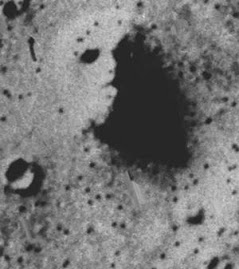
The Great Stone Face


… At the hour of sunset, as had long been his frequent custom, Ernest was to discourse to an assemblage of the neighboring inhabitants, in the open air. He and the poet, arm in arm, still talking together as they went along, proceeded to the spot. It was a small nook among the hills, with a gray precipice behind, the stern front of which was relieved by the pleasant foliage of many creeping plants, that made a tapestry for the naked rock, by hanging their festoons from all its rugged angles. At a small elevation above the ground, set in a rich frame-work of verdure, there appeared a niche, spacious enough to admit a human figure, with freedom for such gestures as spontaneously accompany earnest thought and genuine emotion. ... In another direction was seen the Great Stone Face, with the same cheer, combined with the same solemnity, in its benignant aspect.

Ernest began to speak, giving to the people of what was in his heart and mind. His words had power, because they accorded with his thoughts; and his thoughts had reality and depth, because they harmonized with the life which he had always lived. It was not mere breath that this preacher uttered; they were the words of life, because a life of good deeds and holy love was melted into them. Pearls, pure and rich, had been dissolved into this precious draught. The poet, as he listened, felt that the being and character of Ernest were a nobler strain of poetry than he had ever written. His eyes glistening with tears, he gazed reverentially at the venerable man, and said within himself that never was there an aspect so worthy of a prophet and a sage as that mild, sweet, thoughtful countenance, with the glory of white hair diffused about it. At a distance, but distinctly to be seen, high up in the golden light of the setting sun, appeared the Great Stone Face, with hoary mists around it, like the white hairs around the brow of Ernest. Its look of grand beneficence seemed to embrace the world.

At that moment, in sympathy with a thought which he was about to utter, the face of Ernest assumed a grandeur of expression, so imbued with benevolence, that the poet, by an irresistible impulse, threw his arms aloft, and shouted, "Behold! Behold! Ernest is himself the likeness of the Great Stone Face!"

Then all the people looked, and saw that what the deep-sighted poet said was true. The prophecy was fulfilled. But Ernest, having finished what he had to say, took the poet's arm, and walked slowly homeward, still hoping that some wiser and better man than himself would by and by appear, bearing a resemblance to the GREAT STONE FACE.


– Nathaniel Hawthorne, “The Great Stone Face” (1852)

Terminus